One relationship layer that protects provider revenue during care and grows admissions after care.
Clients, families and alumni. From admission through years after discharge.
$339Krevenue protected · one site
~$42KARR
7paying providers
30,000+Cue sessions
60%client WAU / MAU
[traction]
The problem
Behavioral health operates on 1% visibility in care, and 0% after it.
During care
Providers’ earned revenue is at risk.
Missing medical-necessity evidenceThe right evidence isn't available when utilization review happens.
Preventable early departuresDisengagement is discovered after the decision to leave has formed.
Family risk goes unseenFamily behavior often changes before the stay is threatened.
167 of 168hours of the week unseen · outpatient
1 hr a weekwith the family · residential and adolescent
After care
Earned relationships stop creating value.
Referrals go elsewhereThe next family goes wherever they search that night.
Reviews never happenGrateful clients and families are never asked at the moment they would say yes.
Re-engagement happens too lateRelapse surfaces as a crisis, or remains invisible.
Payer proof disappearsNo longitudinal outcomes to support contracts and renewals.
40 to 60%relapse within a year · SUD [3]
90 to 100 daysalumni engagement decay [10]
The relationship ends while the outcome is still being decided.
Why now
Holding every relationship required payroll no provider could afford.
1coordinator
cannot continuously hold
60clients in care
+
40families
+
300alumni
The turn: Until now, maintaining a meaningful relationship with hundreds or thousands of clients, families and alumni required a human for every interaction. AI changes the cost structure of relationship continuity.
Judgment is still scarce. Presence is not.
The solution
One platform holds every relationship a provider has.
Branded by the provider. Persistent across treatment and beyond.
Clientsown surface · from day oneFamiliesown surface · own accountAlumniown surface · same app
↓
One continuous relationship platform, under the provider's brand.
Persistent relationshipacross treatment and beyond
→
First-party longitudinal dataconsented, from engagement and participation
→
Intelligence + prepared actionwhat changed, who needs attention, the next move · staff decide
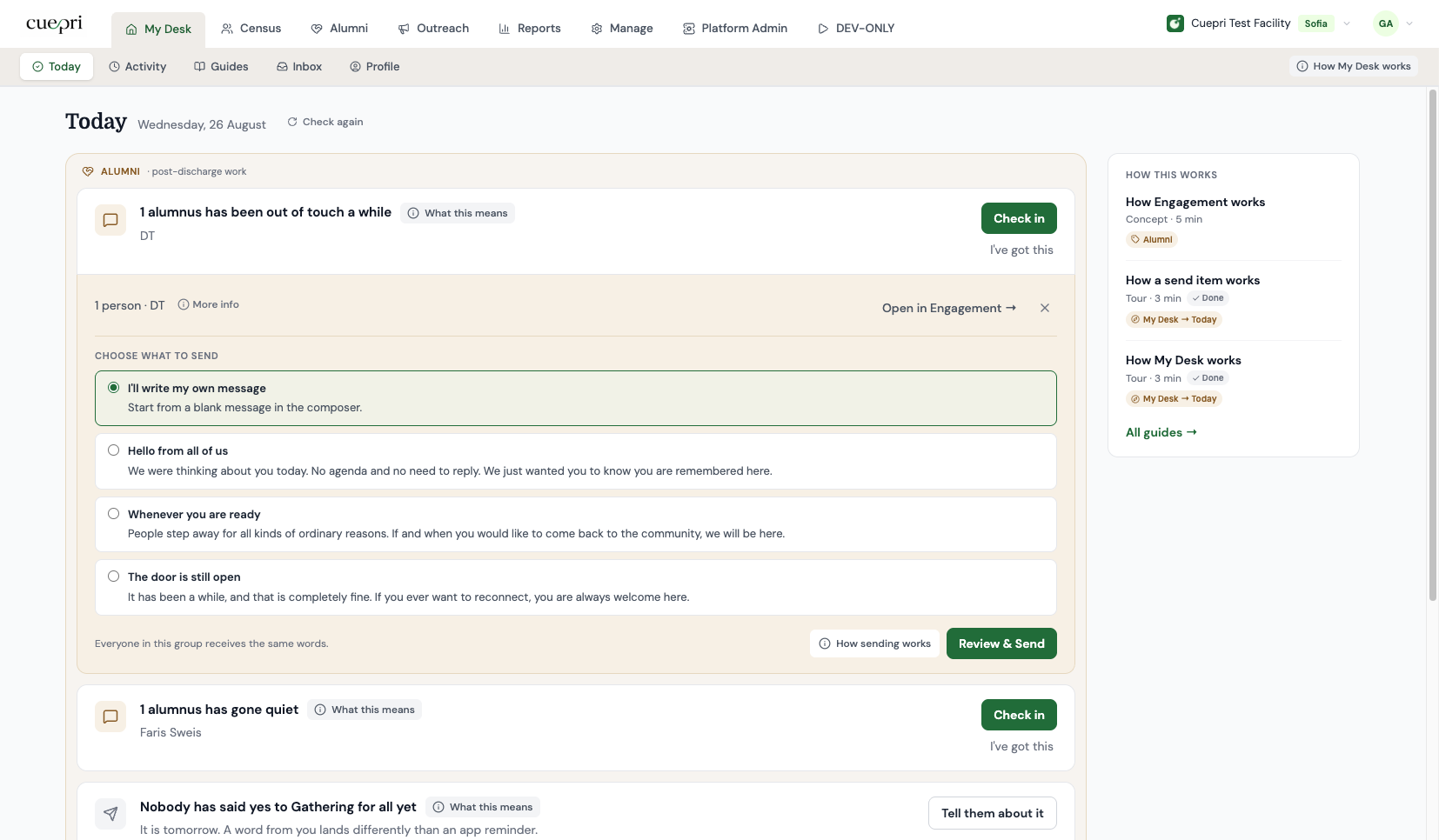
A family stops showing up and completing program activities. Cuepri detects the change.
The director sees why it matters. The warm outreach is already drafted.
The director decides whether to send it.
In careUR / clinician
Cuepri sees an authorization review approaching and detects that evidence supporting continued medical necessity is incomplete.
It identifies the missing evidence, gathers what can appropriately be collected through the client relationship, and prepares the supporting longitudinal narrative.
The clinician/UR team reviews, edits and submits.
Alumnicoordinator
An alumnus drifts from connected to slipping.
The warm opener is already written.
The coordinator sends it, or calls instead.
The AI calls the play. A person carries it.
The product, at work
The signal is not the deliverable. The next move is.
3 views · click or press →
My Desk prioritized work, context, and the next human action
The business case
One relationship. Two revenue loops.
Protect revenue during care
Authorizationevidence completeness · authorized days · denials prevented and reversed
Retentionfamily risk · disengagement · preventable AMA
Measured at our providers38 to 53%
PHP authorized-day uplift; $339K protected at one site, in a market denied at twice the medical rate. [traction][6]
Industry benchmark$800 to $1,500
of revenue at risk for every unused authorized day at commercial residential rates. [12]
Grow revenue after care
Reputationreviews · advocacy
Acquisitionalumni referrals · family referrals
Re-engagementclinically appropriate return to care
Industry benchmark25 to 30%
of admissions at best-practice programs come from alumni referrals. [10]
Model~24 months
of the platform funded by one referred admission. [model]
Community involvement beats every established treatment, including CBT, for long-term abstinence. [1]
The data so far
30,000+ Cue sessions. The relationship catches what forms miss.
Observational results from production data, February to September 2026 unless noted. Clients were in treatment; change reflects the program and Cuepri together. [traction]
13.5% → 25.3%of clients identified with suicidal ideation when Cue conversations are added to the PHQ-9 (SUD program, 245 clients)
1.7 minmedian time for a clinician to open a suicidal-ideation alert (552 alerts)
72%of clients who started with clinical-range depression moved down a severity tier (SUD program, PHQ-9)
82%of 4,700+ Cue conversation ratings were 4 or 5 stars (since May 2025)
60%of suicidal-ideation disclosures to Cue came within two weeks of a PHQ-9 answered "not at all"
~60%of scheduled check-ins and assessments completed by clients
2 in 3clients said yes when Cue offered to loop in their counselor
The form is a snapshot. The conversation is where clients tell the rest of the story.
The landscape
Others own a moment or a population. Cuepri holds the whole relationship.
who it holdsWhole communityclients · families · alumni
Cuepritreatment through years after · clients, families, alumnicreates and captures new relationship-derived evidence before the review
One population
BH EHRsKipu · Alleva · stores what was documented
RCM / UR softwaresees the claim and chart documentation
AI scribesEleos · the clinician's note
Limbicintake and triage
Measurement-based carea survey on a schedule
Provider AI companionsJimini · Ieso · Xaia · Affiniti · one client, during treatment
Alumni appsCaredFor · Team Recovery · Encyrcle · alumni only, from discharge
Family programsPathroot · the family, without the client or the alumnus
AI support and wellnessWysa · Brightn · Alongside · Wayhaven · persistent around one person
Episode-bound
Persists after discharge
when it exists
Clinical systems stop with the episode. Alumni software starts after it. Cuepri spans both, and gives the family its own place.
Why Cuepri wins
Built across time, people, work, and data.
Time
Continuous across the episode boundary.
People
Client + family + alumni together.
Work
Cuepri isn't an insight dashboard; it participates in operational workflows.
Data
Every interaction expands the longitudinal relationship dataset, which improves what Cuepri can detect, collect and prepare.
Every admission adds a client and a family. Every discharge adds an alumnus. The relationship history, provider programming, and staff adoption compound with every cohort.
Market, and how we get in
Enter through one outcome. Expand across the relationship.
$143B → $400B+US behavioral health, 2024 to 2033 [4]
~28,000US facilities
~17,800treating substance use
Land
One measurable economic outcome
Usually alumni or family. Average entry contract is ~$6K a year.
→
Expand
Activate the entire relationship
Client + family + alumni, plus in-care AI workflows for authorization, retention, and clinical risk.
→
Scale
Operator-wide relationship layer
Across facilities.
Why now. Providers live or die on utilization and revenue. Acquisition is expensive. Providers already hold thousands of valuable relationships. AI has made persistent, individualized engagement economically possible.
We don't sell a huge transformation on day one. We enter through an outcome with obvious ROI, establish the relationship layer, then expand across the lifecycle and portfolio.
Traction and the model
From pilot to ~$42K ARR, with five providers signed in six weeks.
Next milestone: $100K ARR by the end of 2026. Pipeline: ~$183K across nine opportunities, ~$122K of it at an advanced stage. [traction]
~$42Kcurrent ARR
~$183Kpipeline · nine opportunities
$100KARR target · end of 2026
7paying providers
Entry · Relationship platform at one facilityCommunity, from $499/mo per connected life, in bands. Branded app, Cue, boards, events, family accounts. Live in days.
Expansion 1 · Revenue protection across censusClinical, $30 per enrolled census member/mo. Roughly $1 a day, roughly 15x ROI: authorization evidence, retention, and UR narratives prepared for staff.
Expansion 2 · Full family and alumni populationFamily Program, $25 per family/mo, up to three members. Families stay on after discharge; Community bands grow with every discharge.
Expansion 3 · Additional facilitiesOne location proves it; the rollout runs across the operator's portfolio. ~75 multi-site platforms in the target segment alone.
A provider's community compounds with every cohort. Every discharge adds an alumnus; every admission adds a family. [model] Documented alumni-program builds are worth $90K to $580K per facility per year; our 24-months-per-referral model is conservative against them. [11]
The vision
Every client, family and alumnus. Every episode. Every provider relationship over a lifetime.
The path to $100M runs inside behavioral health.
Now · proven
Behavioral healthClients, families, and alumni across treatment and recovery.
Next · operator
Every location of an operatorOne relationship layer across the portfolio, from the first facility outward.
Then · lifetime
Every episode, every return to careThe relationship a person keeps with their providers, across treatment, recovery, and readmission.
The same architecture can eventually extend to other high-value longitudinal services.
One credible path
$100M
~1,400 locations × ~$71K mature-location ACV
Average entry contract: ~$6K 80-census program, all three lines at list: Community $1,500 + Family $2,000 + Clinical $2,400 a month ≈ $71K
Equivalent to about 5% of the roughly 28,000 U.S. behavioral-health facilities, before any adjacent market. [model]
Episodic human attention. Continuous customer need. One missing relationship layer.
The team and the raise
Built by the team incumbents would have to acquire.
Our DNA is experience: turning complex systems into products people understand, trust, and return to.
FS
Faris SweisCo-Founder & CEO
27 years building B2B developer platforms at Microsoft, Telerik, and Progress. Co-founded Sentur, the first IFS-centric digital trauma platform.
DT
Dimi TaslakovCo-Founder & COO
Scaled Telerik and OfficeRnD and led transformation at Progress and Sentur. 24 years across product, go-to-market, and operations.
GA
Georgi AtanasovCTO
Engineering leadership across multiple platform builds. Owns the AI-native architecture underneath Cuepri.
MS
Matt ShusterGTM & Partnerships
Drives go-to-market, partnerships, and customer relationships across behavioral health.
Clinical depth
Advised by former addiction-treatment CEOs and clinical leaders with decades across SUD, trauma therapy, and recovery programming.
Raising
$2M
Scale provider acquisition
Productize deployment and integrations
Build the longitudinal family and alumni outcomes dataset
What keeps people well is the same thing that lets a program grow.
The EHR holds the record. Cuepri holds the relationship.
Because the relationship begins during treatment, Cuepri doesn't have to reacquire the client at discharge.
In care · the clientMy Cue, the day's schedule, validated instrumentsFamily · own accountweek-by-week staging, rehearsal: "when they ask to come home"Alumni · same app, reshapedthe milestone in their own words, events, check-ins
Appendix · sources for every number in this deck
Every figure traces to a source.
Research · peer-reviewed
[1] Community involvement beats every established treatment, incl. CBT (Cochrane 2020, 27 studies, n=10,565)pubmed.ncbi.nlm.nih.gov/32159228
[12] Commercial residential per diems $800 to $1,500+/dayadsc.com
Ours
[traction] figures: internal source of truth · [model]: arithmetic from entry pricing, not a measured resultdata/traction.md · verified citation list: research/Cuepri_Evidence_File.md §7